May 31, 2026 • 7 min read
Scan a UPC, Print a Smarter GS1 Barcode Label
CATEGORIES
SOCIAL SHARE
Convert New or Existing Inventory for GS1 Sunrise 2027. Correct Non-Compliant Labels. Scan-to-Print Instantly On-Site.
CodeREADr’s new UPC-to-GS1 relabeling technology lets app users scan traditional UPC barcodes and print GS1 Digital Link, QR, DataMatrix, and Code 128 labels for retail, logistics, and supply chain compliance. Relabeling with RFID tags is coming soon.
GS1 Connect 2026 (GS1 US), taking place June 9–11, 2026, at The Cosmopolitan of Las Vegas, brings together supply chain, retail, healthcare, manufacturing, foodservice, and logistics professionals focused on standardized data exchange and supply chain visibility. It is the right venue to introduce a practical new technology for companies preparing for GS1 Sunrise 2027 and the broader move toward smarter, data-rich product identification.
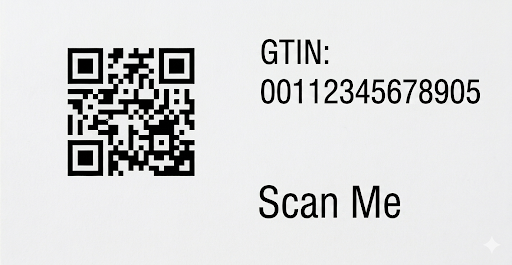
The new CodeREADr technology lets app users scan an existing UPC barcode and immediately print a new GS1-compliant label. The new label can encode the UPC-derived GTIN in a GS1 Digital Link, GS1 QR Code, GS1 DataMatrix, or GS1-128 / Code 128 barcode. It can also include additional GS1 Application Identifiers, such as lot number, serial number, expiration date, production date, batch number, net weight, count, SSCC, or other GS1-compliant data selected by the CodeREADr account administrator.
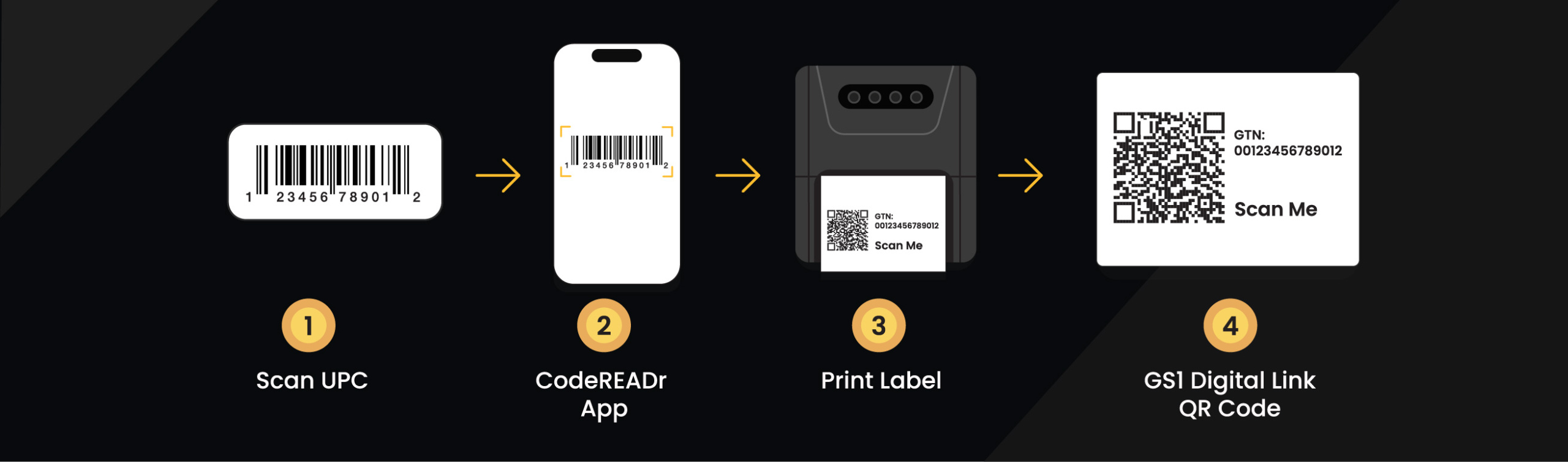
The result is simple: scan the existing UPC, transform the data, print the new label, and apply it immediately to the item, inner pack, case, pallet, tote, container, or shipment.
Why this Matters Now
The GS1 Sunrise 2027 initiative is helping industry move toward 2D barcodes that can be scanned at retail point-of-sale and support richer data for supply chain, traceability, and consumer engagement. GS1 US describes Sunrise 2027 as a path toward 2D barcode readiness, including GS1 Digital Link implementation, with the goal of enabling 2D barcodes to be scanned and processed at retail POS by the end of 2027.
But many companies face a practical problem: they already have inventory, packaging, cartons, pallets, or shipments labeled only with UPC codes or barcodes that do not meet the requirements of trading partners, logistics providers, retailers, healthcare organizations, or internal systems.
Replacing all packaging may be too slow, too costly, or unnecessary. CodeREADr’s UPC-to-GS1 labeling technology is designed to close that gap.
What the Technology Does
With CodeREADr, an authorized app user can scan a UPC barcode and have the app format the data into a GS1-compliant output for immediate printing.
Depending on the account configuration, the printed label may include:
- GS1 Digital Link QR code for web-enabled product identity and consumer or business data access.
- GS1 DataMatrix for compact item-level, healthcare, regulated, or space-constrained labeling.
- GS1-128 / Code 128 barcode for logistics, cartons, pallets, and shipping workflows.
- Additional GS1 AIs such as lot, batch, serial number, expiration date, production date, packaging date, count, weight, or SSCC.
- Human-readable text, internal IDs, handling instructions, location information, or customer-specific data.
- In the near future, the ability to print and encode an RFID tag as part of the relabeling workflow.
The technology is especially useful when companies need field-ready relabeling without building a full systems integration. For companies that do want deeper automation, CodeREADr can also support integrated workflows using Postback, validation services, APIs, and connected databases.
Key Use Cases
1. Preparing New or Existing Inventory for GS1 Sunrise 2027
Many products only have a traditional UPC barcode. CodeREADr can help brands add GS1 Digital Links or other GS1-compliant 2D barcodes before they reach retail, distribution, or downstream trading partners.
This technology can be valuable for brands, distributors, retailers, and logistics providers that need a practical transition strategy for inventory already in warehouses, stores, or fulfillment centers.
2. Correcting Non-Compliant Shipments
Shipments may arrive with barcodes that are missing required data, encoded in the wrong format, damaged, poorly printed, or incompatible with a recipient’s receiving process.
CodeREADr can be used at receiving, staging, quality control, or outbound shipping to scan the existing UPC and print a corrected GS1-compliant label for the item, case, pallet, or container.
3. Adding Lot, Batch, Serial, or Expiration Data
A UPC identifies the trade item, but many operational workflows require more. A relabeling process can add GS1 AIs for lot number, batch number, serial number, expiration date, best-before date, production date, or packaging date.
This is useful for food, beverage, healthcare, cosmetics, chemicals, electronics, and regulated products where traceability, recalls, warranty control, or expiration management matter.
Note: These GS1 Application Identifiers would most likely be applied after scanning the item’s unique identifier (e.g., serial number). Alternatively, after scanning the UPC code, the app user can use Optical Character Recognition (OCR) to capture these identifiers if printed on the item.
4. Case, Carton, and Pallet Labeling
Companies often need to move from item-level UPCs to logistics labels for cartons, pallets, or shipments. CodeREADr can help generate labels for secondary and tertiary packaging, including GS1-128 or 2D symbols with the data required by logistics providers, retailers, warehouses, or customers.
This is especially valuable for SMEs that cannot justify a full warehouse management system integration but still need accurate, standards-based labeling.
5. Private Label, Rework, and Kitting Operations
Products are often relabeled during rework, kitting, bundling, repackaging, or private-label operations. CodeREADr can help teams scan the original UPC and print a new label that reflects the correct product identity, bundle configuration, internal SKU, lot, serial, or customer-specific data.
6. Returns, Refurbishment, and Reverse Logistics
Returned goods may have missing, damaged, outdated, or non-compliant labels. CodeREADr can support reverse logistics teams by generating new GS1-compliant labels during inspection, refurbishment, repackaging, restocking, or redistribution.
7. Retail Shelf, Backroom, and Store-Level Relabeling
Retailers may need to relabel items in stores or distribution centers to ensure inventory accuracy, handle product recalls, manage price changes, track expiration dates, streamline markdown workflows, or prepare for Sunrise 2027. A mobile scan-to-print workflow can make this practical without requiring staff to use a desktop system.
8. Healthcare and Clinical Supply Labeling
For healthcare, pharmaceuticals, medical devices, and clinical trials, GS1 DataMatrix is often a preferred carrier because it can encode more data in a compact space. CodeREADr can support workflows in which existing identifiers need to be converted, supplemented, or relabeled with additional GS1 AI data to enhance traceability and verification.
9. Product Authentication and Consumer Engagement
GS1 Digital Link can connect a product identity to web-based information controlled by the brand. Relabeling can help companies add links to product pages, recall information, instructions, certificates, promotions, sustainability data, or authentication workflows.
10. Future RFID Enablement
As RFID adoption grows, companies may want to supplement barcodes with RFID tags to improve counting speed, inventory visibility, pallet tracking, asset movement, or automated receiving. CodeREADr’s planned RFID relabeling capability can help bridge the transition from barcode-only identification to barcode-plus-RFID workflows.
Designed for Practical Deployment
Many companies understand the value of GS1 standards but lack the time, budget, or internal IT resources for a full integration. CodeREADr’s approach is designed to make relabeling practical:
Scan with the CodeREADr app.
Use iOS or Android smartphones, tablets, rugged devices, or compatible scanning hardware.
Validate and format the data.
Transform the scanned UPC into the proper GTIN structure, GS1 Digital Link, or GS1-compliant barcode format. Add required AIs based on administrator-defined rules.
Print immediately.
Send the formatted data to a compatible label printer and apply the label at the point of need.
Control the workflow.
Administrators can define what data is required, how the label is formatted, which users can print, and whether scans are validated on-device, online, or through hybrid workflows.
Why CodeREADr?
CodeREADr is already used for barcode scanning, validation, data capture, and workflow automation across retail, logistics, manufacturing, healthcare, and events. This new UPC-to-GS1 labeling service extends that capability from scanning and validation into real-time relabeling.
For companies preparing for Sunrise 2027, improving logistics compliance, correcting shipment labels, or adding richer GS1 data to existing inventory, CodeREADr offers a practical path forward.
You do not always need a full system integration to begin modernizing your labeling workflows. Sometimes the fastest first step is to scan the barcode you already have and print the barcode you now need.
See CodeREADr at GS1 Connect 2026
CodeREADr will introduce this technology at GS1 Connect 2026 in Las Vegas. Attendees interested in GS1 Digital Link, Sunrise 2027 readiness, logistics labeling, scan-and-print workflows, or future RFID enablement are invited to connect with CodeREADr to discuss pilot opportunities and deployment scenarios.
Contact support@codereadr.com to set up a meeting at GS1 Connect 2026 or meet virtually at any time. Simply mention “Scan to Print” in the email subject.