Sept 23, 2026 • 5 min read
Indexing Technology Can Lead to Near-Perfect Receiving Accuracy
CATEGORIES
SOCIAL SHARE
Verify the correct order items and quantities with a simple barcode label and the CodeREADr app. No integration with ERP, WMS, or TMS is required.
How it works
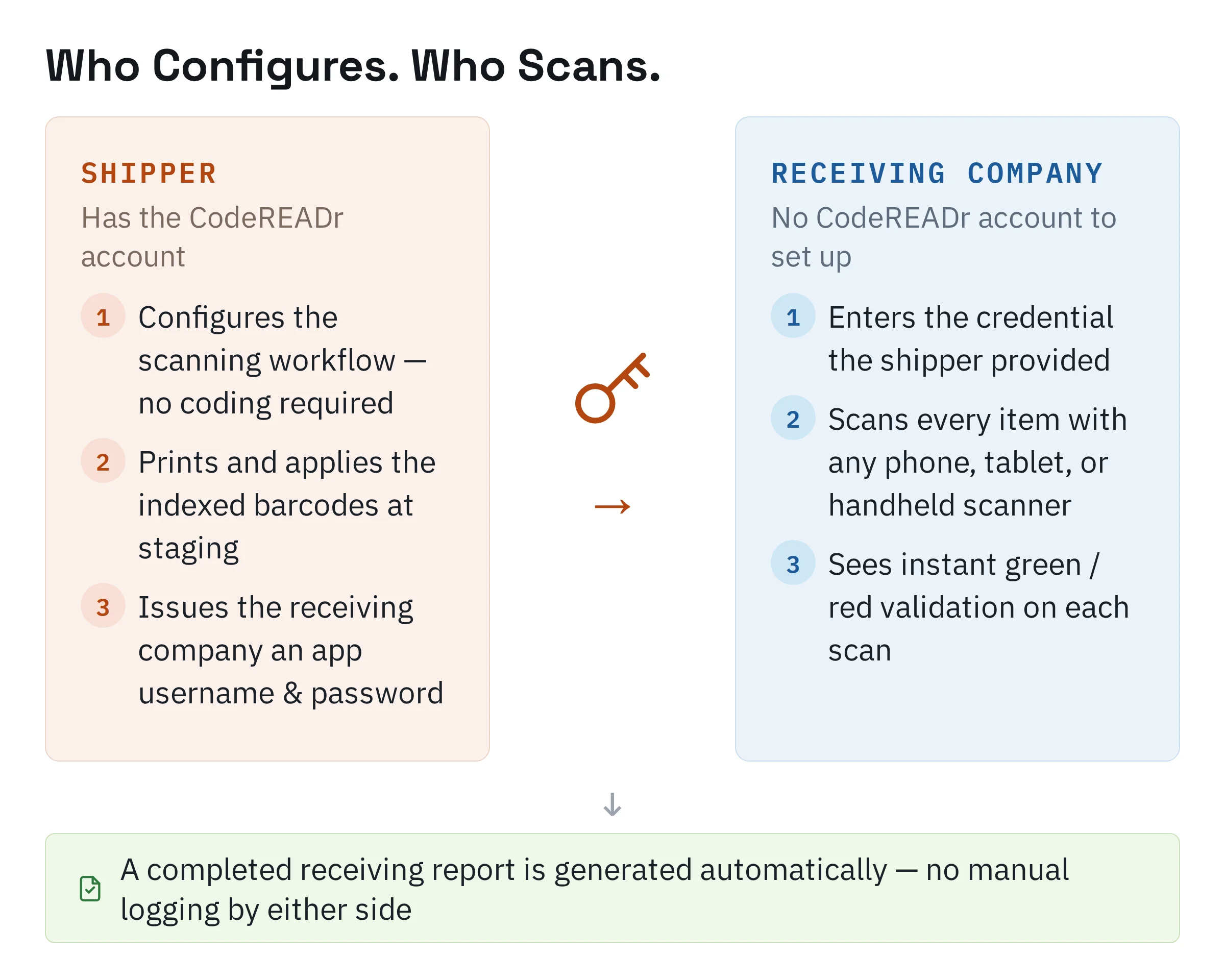
The shipper affixes barcodes when staging or palletizing the order: one summary barcode per shipment and one indexed barcode per item. The shipper enters their own app username to scan during staging. For receiving, the shipper issues the receiving company an app username and password. This can be an email address the receiver provides (e.g., receiving@company.com) or a simple text-based username (e.g., company-receiving), so the receiving team can start scanning items on arrival and receiving reports without setting up or managing their own CodeREADr account.
From there, the receiving process is simple:
- Scan the order summary barcode. The receiver scans the summary code on the packing slip, bill of lading, or pallet manifest. This loads the expected order parameters — including total item count — directly into the mobile app.
- Scan each item’s index barcode as it’s unloaded and processed.
- Get immediate on-screen validation on every scan: a green alert confirms the item and unit count match the expected order; a red alert flags an invalid item, incorrect quantity, or duplicate scan — catching double-counts before they become a discrepancy.
- Track completion live. The app shows real-time progress and issues a final alert once every required unit and item has been accounted for.
Because validation happens entirely using data embedded in the barcode itself, receiving teams can verify even mixed pallets or multi-supplier shipments instantly at the dock. No integration with ERP, WMS, TMS, or other database is required.
What’s actually inside the barcode
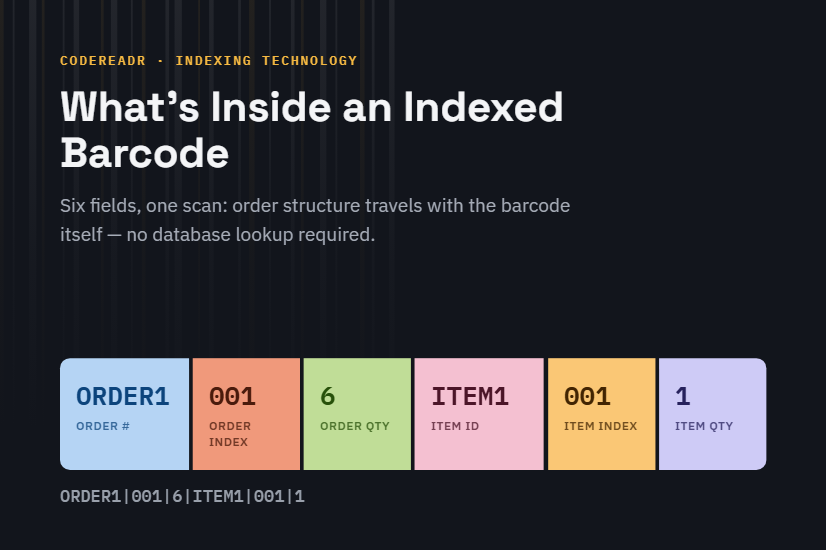
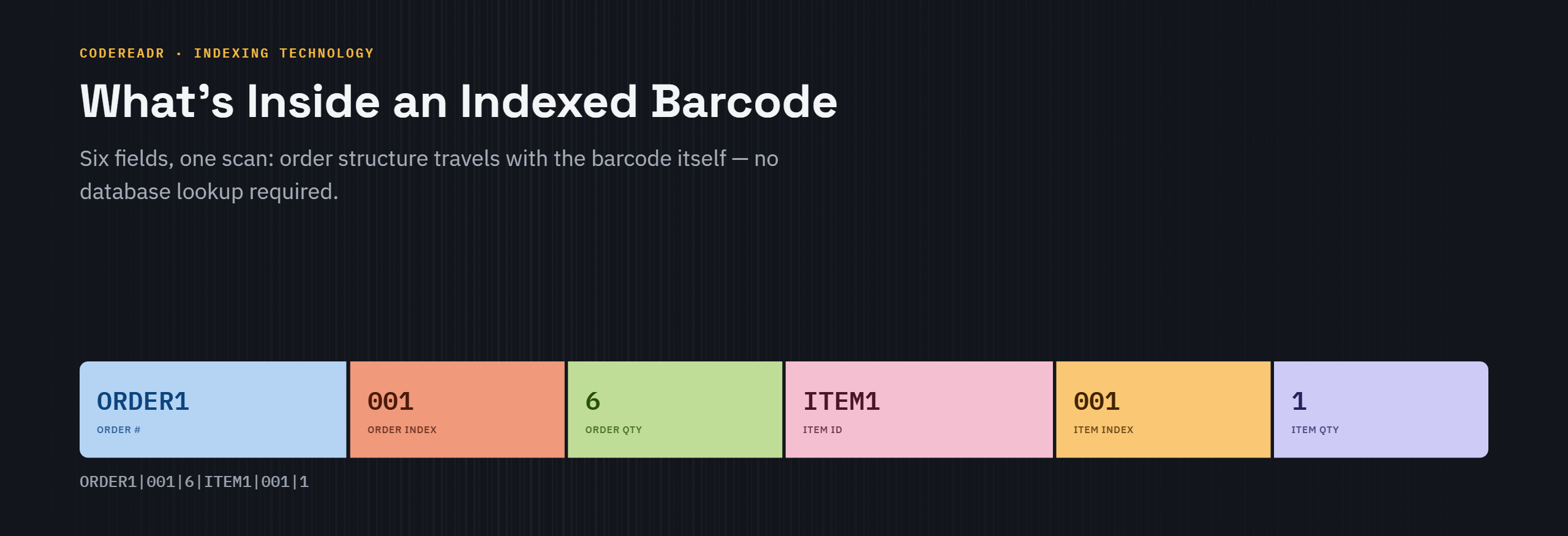
CodeREADr’s indexing system uses two barcode formats, shown below with each field color-coded.
Format 1 — order summary barcode
| ORDER1 | 6 |
ORDER#
TOTAL_ORDER_QTY
Example: ORDER1-6 represents Order #1 containing a total of 6 items.
Format 2 — detailed pipe-delimited item index
| ORDER1 | 001 | 6 | ITEM1 | 001 | 1 |
ORDER#
ORDER_INDEX
TOTAL_ORDER_QTY
ITEM_ID
ITEM_INDEX
TOTAL_ITEM_QTY
Field breakdown:
- ORDER_NUMBER: Identifier for the overall order
- ORDER_INDEX: Sequential number of the item within the entire order
- TOTAL_ORDER_QTY: Total number of items in the order
- ITEM_ID: Identifier for the specific item type (UPC, SKU, etc.)
- ITEM_INDEX: Sequential unit count for that specific item type
- TOTAL_ITEM_QTY: Total quantity ordered for that specific item type
Example: six scans for an order of six items across three item types
| ORDER# | ORDER_INDEX | TOTAL_ORDER_QTY | ITEM_ID | ITEM_INDEX | TOTAL_ITEM_QTY | Meaning |
|---|---|---|---|---|---|---|
| ORDER1 | 001 | 6 | ITEM1 | 001 | 1 | 1st item in order; only unit of ITEM1 |
| ORDER1 | 002 | 6 | ITEM2 | 001 | 2 | 2nd item in order; ITEM2 unit 1 of 2 |
| ORDER1 | 003 | 6 | ITEM2 | 002 | 2 | 3rd item in order; ITEM2 unit 2 of 2 |
| ORDER1 | 004 | 6 | ITEM3 | 001 | 3 | 4th item in order; ITEM3 unit 1 of 3 |
| ORDER1 | 005 | 6 | ITEM3 | 002 | 3 | 5th item in order; ITEM3 unit 2 of 3 |
| ORDER1 | 006 | 6 | ITEM3 | 003 | 3 | 6th item in order; ITEM3 unit 3 of 3 |
That’s what lets the app catch a duplicate scan, a missing item, or a miscount without ever connecting to a database — the order’s entire structure travels with the barcode.
IMPORTANT: Here’s how to configure the CodeREADr app and generate barcodes for testing and deployment in 15 minutes.
Why this matters beyond the receiving dock
The immediate win is obvious: fewer discrepancies, resolved when they would otherwise become a problem, instead of surfacing days later during a cycle count or a customer complaint.
But the value extends further up and down the supply chain:
- The shipper benefits, too. Because the same barcode format can be verified at staging, in transit through any third-party warehouse or carrier touchpoint, and at final receipt, everyone handling the shipment is working from the same source of truth. A shipper who can prove exactly what left the dock — and a receiver who can prove exactly what arrived — removes the ambiguity that usually turns into a finger-pointing exercise.
- Faster payment cycles. Invoice disputes over quantity discrepancies often delay payment. When receipt of every unique item is memorialized by its own scanned barcode, there’s no gap between what was shipped, what was invoiced, and what was received, removing one of the most common reasons a payment gets held up for “verification.”
- Cleaner warranty tracking. Because each item has a unique index barcode, its warranty period can be memorialized from the actual date of confirmed receipt — not an estimated ship date or an assumed delivery window. That’s a meaningfully cleaner record for both the seller and the customer if a warranty claim comes up later.
- Audit-ready records, automatically. Every scan generates a timestamped record tied to a specific item and order — no manual logging required, and no reliance on someone remembering to write down a count.
There are almost certainly more downstream benefits specific to your operation — fewer chargebacks, better vendor scorecards, reduced labor spent chasing down “Where did this pallet actually go?” questions. But the throughline across all of them is the same: because the accuracy check happens at the moment of physical handoff, using a barcode you’re likely already printing and scanning, indexing adds very little incremental cost to catch errors that would otherwise cost far more to unwind later.
Can indexing work with RFID?
Absolutely. Contact support@codereadr.com to learn when the RFID version will be launched.